Looking at Tesla

Investors in iconic electric vehicle company Tesla should take heed: The stock is overvalued. And its not just a little pricey. The odds are against the company’s financials being sufficient to justify the recent price

Tesla: Great Company, Too Pricey While Elon Musk’s company has managed to pull off the improbable — supercharging the longstanding dream of making electric vehicles available to the mass market — the math behind justifying the current stock price makes little sense.

As a recap, the stock is up 410% in the year through Friday, versus a gain of 16% for the S&P 500, according to data from Yahoo. Neither figure includes dividends. That stellar performance alone doesn’t make the stock overvalued.

P\E nightmare

The first is Tesla’s forward looking price-earnings ratio, which is now at 200, according to Morningstar. Put simply, the price of the stock is currently trading at 200 times next year’s profits.

To put that in context, some investors worry that the S&P 500 is overvalued because its forward P/E is around 25, far above historic norms. If the market as a whole is overvalued then surely a stock trading at almost 10 times higher (on a P/E basis) is overvalued? Maybe, maybe not. The high P/E alone isn’t enough to damn the stock as overvalued.

If the growth of the profits is fast enough then theoretically the stock could be fairly valued even with a mega-high P/E. However, the higher the P/E is above what is normal the more difficult it is to justify.

In essence, it comes down to a simple question: Is it probable for the profits of Tesla to grow enough to justify its current price? If it isn’t, then the stock is too pricey.

Revenge of the Actuaries

Friday I spoke with Julian Koski, chief investment officer at New Age Alpha, Westchester NY. She explained that his company looked at the most recent 16 quarters of Tesla’s financial statements and then tried to figure out whether the company would likely make enough money to justify its lofty price.

Koski and her team use actuarial methods to calculate the odds that a company will make the profits that investors are expecting. For those who don’t know, actuaries are super mathematicians who try to work out the probabilities of events happening in the future.

Odds of Tesla failing

In this case, the answer was that Tesla was 55% likely to fail to meet the required profit level, Koski says. Or put another way, more likely than not the company will fail to make as much money as investors are expecting.

Anyone who has played cards knows that it is prudent to fold your hand when the odds are against you. And for investors in Tesla, the time to fold may have come.

Why cryptocurrencies can’t and won’t succeed

Why cryptocurrencies can’t and won’t succeed

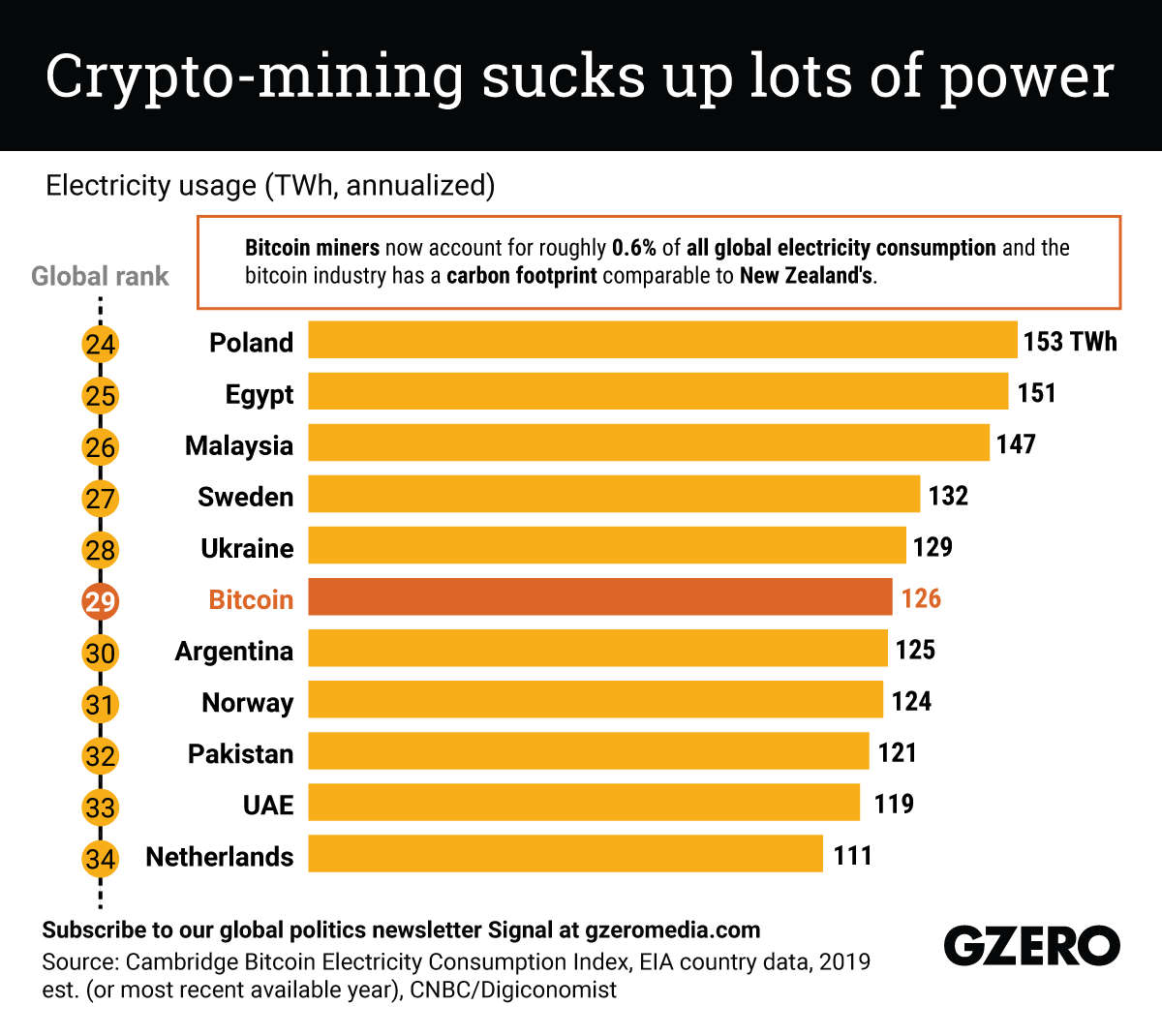
As the price of Bitcoin has skyrocketed in recent months, so has the amount of energy that procuring it hogs. Research shows that Bitcoin “mining” now uses 80 percent more energy than at the start of 2020. Billionaire philanthropist Bill Gates recently sounded the alarm on crypto, saying that he would not invest in Bitcoin because mining for the digital currency requires huge amounts of energy, much of which is powered by fossil fuels that harm the environment. So where does Bitcoin rank in electricity consumption compared to nations?

Understanding Bitcoin

Summary
Volatility is a huge risk factor and source of inefficiency.
Safety is a real issue.
Unmanaged, largely unregulated nature present additional risks.
Greater regulation of cryptocurrencies appears likely.
Central bank backed digital currencies could derail cryptocurrencies.        

The rise of cryptocurrencies over the last few years has created an unwelcome element of risk in a world economy and society already full of them. The utility of cryptocurrencies is highly suspect, and the risks and dangers they present far outweigh any perceived benefits.                           

What are they anyway?
Many people wonder what cryptocurrencies are, and what their purpose is. The answers to that question – and there are several – should give investors pause. Trying to explain how they work or why they should go from curiosity to mainstream use should also draw a healthy dose of caution and doubt. All this leads to a very good question: why bother with them in the first place? For purposes of a briefer discussion, I’ll focus on Bitcoin (BTC-USD) as the leading cryptocurrency.                     

The Origins of Bitcoin
Bitcoin originated in 2009 as a software program by an anonymous creator or creators known by the alias Satoshi Nakamoto. The software rewards those who solve its increasingly complex computer puzzles (cryptography) with Bitcoin. Roughly 900 Bitcoins are created every day by massive, high-powered computers solving those highly complex puzzles, otherwise known as mining. Roughly 18.5 million of the maximum total of 21 million Bitcoins have been mined. Roughly every four years, the software halves the reward for mining bitcoin, while the puzzles become increasingly complex to solve, requiring more computing power. It’s unclear if any of this software programming can be changed. After all Bitcoins have been mined, it is said that Bitcoin miners will maintain the network with fees. How, or how much, the fees will be assessed remains an open question.   

Extremely Inefficient
US Treasury Secretary Janet Yellen has called Bitcoin an “extremely inefficient” transaction mechanism, among other things. Part of the reason is the cost to create a Bitcoin. The electricity used by computers to mine Bitcoins is estimated to leave a carbon footprint roughly equal to that of New Zealand – estimated at 78.9 million tons of CO2 equivalent in 2018. This of course begs the question of how much does it cost to mine a Bitcoin – outside of the carbon cost?

The estimated answer is that in parts of China- Inner Mongolia being one of them- where most Bitcoin miners are thought to operate because of low electricity cost – only about 4 cents a kilowatt hour – the electrical cost to mine a Bitcoin ranges between $5,000 – $8,500, depending on the size of the bitcoin mining operation. Presumably there is a cost for the computers and other costs too. And given that the Bitcoin reward halves every four years – the next time is estimated to occur in 2024 – that means the cost to mine a Bitcoin will double – assuming Bitcoin mining costs don’t increase. But that seems unlikely.                  

China Banning Bitcoin Mining
The reason it seems unlikely is because China is banning Bitcoin mining operations in Inner Mongolia, home to cheap and dirty coal, and will shut them down beginning in April. China is also clamping down on virtual currency transactions and has banned new coin offerings. It’s estimated that 65% of Bitcoin miners are located in China, because of cheap energy, labor, and chip manufacturing. 90% of Bitcoin trades are thought to have originated in China in the past, but that percentage has declined due to the clampdowns, forcing crypto-traders to move outside of China.

Okay, so we know that Bitcoin, the most popular cryptocurrency, is: a cryptography software network created anonymously; is produced mostly in obscure parts of China with cheap electricity, labor, and computer parts by solving complex computer puzzles; China doesn’t support it; It’s value, while quite volatile, has increased near parabolically recently, as has its profile, and some are saying it could become the currency of choice for international trade.

What could go wrong?                   

The first thing to understand about cryptocurrencies is that its main purported strength – decentralization – is also a weakness. There is no strong authority defending the currency, or regulating it, and no country is bound to it. That makes it easier for countries to regulate them, or even ban them if they choose. It’s not too difficult to anticipate more regulations on cryptocurrencies in the near term. China and other countries in Asia have begun that process, and seem likely to continue down that path, which could bring adverse consequences to its value.      Comments from both Treasury Secretary Yellen, the Boston Fed President Eric Rosengren, the New York Attorney General, and authorities in China all suggest more cryptocurrency regulation is coming. Added regulations bring costs, which will be passed on to those that use cryptocurrencies. That is unlikely to support their value, or widespread adoption and acceptance.

Additionally, cryptocurrency is attracting the attention of the IRS. Atop the 2020 form 1040 is a question if you’ve had any dealing in cryptocurrency. The IRS has already sent out over 10,000 letters to taxpayers thought to have been involved in cryptocurrency transactions that may be subject to tax, such as being paid in cryptocurrency, or making a profit in one. Failing to report taxable cryptocurrency transactions could result in some hefty fines. And given that a notable amount of cryptocurrency transactions is known to occur in illicit enterprises, or gambling that may or may not be legal, dealing in cryptocurrency could draw some additional law enforcement scrutiny as well.

Secondly, there are safety concerns with cryptocurrencies. As a virtual currency, or store of value, or whatever you want to call it, it only exists in cyberspace. If you lose the key to your digital currency wallet, there is no password reset option. Whatever digital currency was in your digital wallet then becomes inaccessible forever. It’s not gone, it’s just lost forever. It’s estimated that roughly 3-4 million Bitcoins – out of the 18.5 million created so far – have been lost permanently.

Additionally, what we’ve all come to know is that if it’s in cyberspace, it can be hacked – and stolen – with no recourse. The bank isn’t going to refund your loss or cancel the transaction. This isn’t a minor issue either. Nearly 1 million Bitcoins have been known to have been stolen, 850,000 in the Mt. Gox hack, and another 120,000 in the Bitfinex hack. There may have been others.

It’s also thought that the anonymous creator of Bitcoin, known by the alias Satoshi Nakamoto, may have kept a few Bitcoin for his/her own use. 900,000 some claim, while others claim it’s more like 300,000. Nobody knows for sure. But what if he/she decided to dump his/her Bitcoin? What if his/her/their identity became known? Some claim either event could cause Bitcoin’s value to plummet.

In any case, with China shutting down cryptocurrency miners and clamping down on cryptocurrency transactions, the New York AG warning the cryptocurrency industry, “play by the rules or we will shut you down,” and Treasury Secretary and Former Fed Chair Janet Yellen warning about “extremely inefficient” Bitcoin, and the Boston Fed President predicting the Bitcoin boom won’t last, you can bet there are headwinds cryptocurrencies will be facing going forward, which likely will result in more volatility in their prices

Debt financing what is it and how to benefit

Having developed an apparatus for dealing with uncertain streams we can now approach the heart of the cost-of-capital problem by dropping the assumption that firms cannot issue bonds. The introduction of debt-financing changes the market for shares in a very fundamental way. Because firms may have different proportions of debt in their capital structure, shares of different companies, even in the same class, can give rise to different probability distributions of returns. In the language
of finance, the shares will be subject to different degrees of financial risk or “leverage” and hence they will no longer be perfect substitutes for one another.


To exhibit the mechanism determining the relative prices of shares under these conditions, we make the following two assumptions about the nature of bonds and the bond market, though they are actually stronger than is necessary and will be relaxed later: (1) All bonds (including any debts issued by households for the purpose of carrying shares) are assumed to yield a constant income per unit of time, and this income is regarded as certain by all traders regardless of the issuer.


(2) Bonds, like stocks, are traded in a perfect market, where the term perfect is to be taken in its usual sense as implying that any two commodities which are perfect substitutes for each other must sell, in equilibrium, at the same price. It follows from assumption (1) that all bonds are in fact perfect substitutes up to a scale factor. It follows from assumption (2) that they must all sell at the same price per dollar’s worth of return, or what amounts to the same thing must yield the same rate of return. This rate of return will be denoted by r and referred to as the rate of interest or, equivalently, as the capitalization rate for sure streams.

We now can derive the following two basic propositions with respect to the valuation of securities in companies with different capital structures:
Proposition I. Consider any company j and let Xi stand as before for the expected return on the assets owned by the company (that is, its expected profit before deduction of interest). Denote by Di the market value of the debts of the company; by Sj the market value of its common shares; and by Vj=Sj+Dj the market value of all its securities or, as we shall say, the market value of the firm. Then, our Proposition I
asserts that we must have in equilibrium:
(3) Vi (Sj + Dj) = Xjl/pk, for any firm j in class k.
That is, the market value of any firm is independent of its capital structure and is given by capitalizing its expected return at the rate Pk appropriate to its class.
This proposition can be stated in an equivalent way in terms of the firm’s “average cost of capital,” Xj/Vj, which is the ratio of its expected return to the market value of all its securities.

An in depth look at how to reduce markey volatility

Foreign exchange markets are the most liquid financial markets in practice. The traded volume has even increased within the last years: the daily average turnover on the foreign exchange spot market has surged to 621 billion US dollar in 2004 (cf. the triennial central bank survey by Galati et al. (2005)).

But the enormous trading volume is not the only striking feature of currency markets: the prices of the currencies, that is, the exchange rates, also incorporate information very rapidly. This yields volatility. It can not be denied that instable exchange rates can have dire consequences for whole economies.

Exchange rate uncertainty affects international trade, the liquidity of firms which have foreign debts, the behavior of foreign investors, and even fiscal, domestic, and monetary policy. In general, excess price volatility decreases the willingness of investors to engage in trading activities in the concerned markets. Currency speculation is not the only factor in exchange rate determination, although it seems to have an influence on the short-term development of a currency’s value. There
exist different sights on the influence of speculative currency trade on exchange rates.


In 1936, John M. Keynes partitioned trading parties on financial markets in long-run investors and short-run speculators, whereas speculators play a price-destabilizing role on the market. In his fundamental work The general theory of employment, interest, and money, he pointed out that the imposing of a transaction tax on markets could increase the weight of long-term fundamentals of the assets against speculators’ guesses of the short-term behavior of other speculators, thus stabilizing the asset’s price.

Friedman (1953) contrasts that stabilizing speculation is equivalent to profitable speculation: If speculators buy an asset when its price is low and respectively sell it when its price is high, this will drive the asset’s price towards its equilibrium. This sight on the relation between speculation and stabilisation seems tenuous. For example, de Long et al. (1990)find that because noise traders can earn higher profits than long term investors and both types of speculators are trading, Friedman’s model appears incomplete. Carlson and Osler (2000) argue that Friedman’s line of reasoning does neither incorporate interest rates nor a risk model, which both could in fact make speculators sell an asset when its price is low and buy it when its price is high, thus destabilizing the price.

In general, most post-Keynesian authors assert the opposite of Friedman’s theory. 1 see Keynes (1936) How can one cope with price volatility? In this article, we focus on a transaction taxation scheme. Sticking to the example of foreign exchange markets, there is a constantly ongoing discussion about imposing transaction costs to reduce exchange rate variation.

James Tobin (1978) proposed a transaction tax of up to 1 percent on all spot transactions. He hoped not to affect long-term investors, but to scare away short-term speculators with his tax. The desired effects of such a tax on short-term and long-term currency traders can be illustrated in an example which has been drawn up by Frankel(1996):

Consider a home interest rate of ten percent and a transaction tax in the height of one percent. A foreign asset is attractive to potential investors with an investment horizon of one year if it yielded at least 11.11 percent per annum if only the interest
earnings were brought back.

If the horizon was only one month, the asset should yieldat least 22.12 percent annual revenue to remain attractive. The shorter the horizon, the higher the asset yield has to be: A duration of the investment of one week would require a yield of 62.52 percent, and if it was a one-day investment the yield would have to be no less than 378.68 percent.

This approach is highly controversial. In their comprehensive standard work, Grunberg et al. (1996) review current arguments for and against this tax from an economic point of view. Major points of critics are for example that it would be easy to evade the tax by means of financial engineering (e. g., short-termed futures are not subject to this tax) or by shifting markets to countries where the tax is not imposed. Furthermore, Aliber et al. (2003) find in an empirical study that higher transaction costs are positively correlated with exchange rate volatility. Hau (2006) studies data from the Paris stock exchange and comes to a similar conclusion. Spahn (1996) extends Tobin’s taxation scheme by modelling a two-tier transaction taxation scheme: like in Tobin’s approach, a fixed percentage of up to 1 percent is imposed on all currency spot transactions.

If however the exchange rate lies out of the boundaries of a pre-calculated threshold determined by a crawling peg plus a safety margin, a transaction tax with a significantly higher tax rate of up to 100 percent will be imposed on the transactions. Spahn calls his approach a Tobin-cum-Circuit-Breaker Tax. A more detailed view on this approach is provided bySpahn (2002). Already in the same issue of the journal in which Spahn initially published his taxation proposal, Janet Stotsky (1996) animadverts his approach. She claims that 3 variable taxation rates would increase uncertainty on the market, spreads, as well as the administrative burden for tax payers and tax authority.

Furthermore, in her opinion the levy of the tax as an instrument of monetary policy under the control of the fiscal authority would require a high extent of cooperation between the fiscal and monetary authorities which she claims does not exist in practice.


In the context of politics, the concept of a Tobin tax is reoccurring in discussions frequently; especially in European countries and after financial crises. The interest in
the Tobin tax soon dies once the media coverage on financial crises ceases to exist. Asmall anecdote describes this phenomenon best. Otmar Issing, chief economist of the German Bundesbank in 1990-98, once told journalists when asked about the Tobin tax “Oh, that again. It’s the Loch Ness Monster, popping up once more.”. Nevertheless, some hesitant steps towards such a tax are taken. In 2004, France and Belgium agreed to introduce a Tobin tax as soon as all other countries of the European Union will do.


Germany, France, and Austria claimed pro-Tobin tax positions only in 2005, knowing that if the European Union levied a Tobin tax it would have an own source of fiscal
revenues. On the American continent, Brazil’s president Luiz In´acio Lula da Silva,Venezuela’s president Hugo Chavez, as well as the Canadian House of Commons spoke out in favor of the Tobin tax within the previous 8 years. At the moment, one of the major adversaries of the Tobin tax is the United States of America. It is unlikely that a Tobin tax will be effective if introduced multilaterally without participation of the USA.


There exist different views on the impact of a Tobin tax on financial crises. Whereas some authors, e. g. Tobin (1996a), claim that financial crises caused by an inadequate
monetary and fiscal policy mix and sparked off by speculative attacks could at least have been curbed by a transaction tax, some authors assert the opposite.
Design a site like this with WordPress.com
Get started